


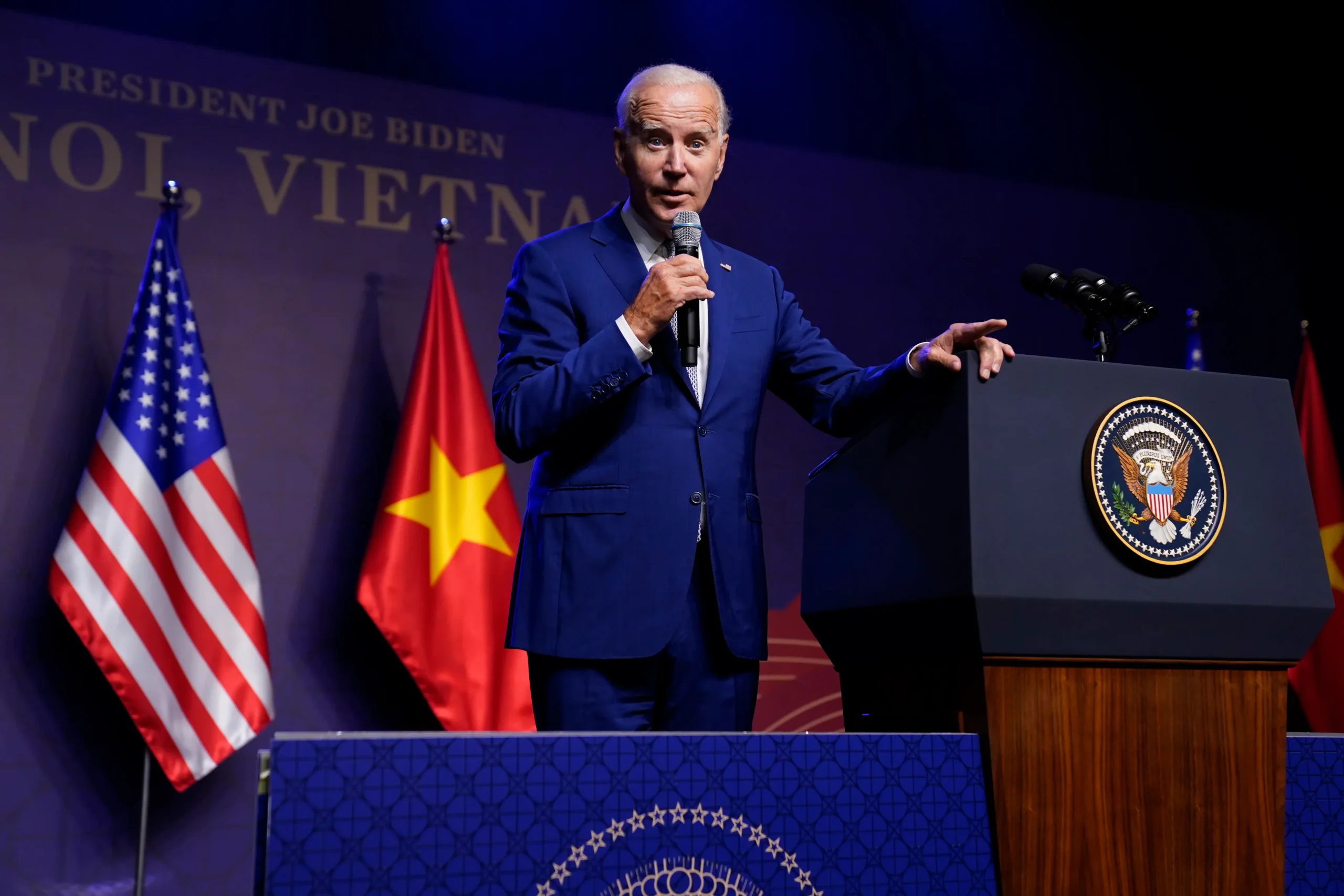
President Joe Biden has suggested that China’s recent economic struggles could potentially dissuade them from pursuing aggressive actions against Taiwan, asserting that Chinese President Xi Jinping currently has his hands full dealing with these challenges. Speaking during his visit to Vietnam after attending the Group of 20 (G-20) leaders’ summit in India, Biden mentioned his meeting with Chinese Premier Li Qiang at the summit and explained his prolonged absence of 10 months from direct talks with President Xi, who chose not to attend the G-20 summit without offering an explanation.
The next anticipated meeting between the two leaders is slated for the Asia-Pacific Economic Cooperation (APEC) summit scheduled for November in San Francisco. Biden elaborated on China’s economic issues, stating that the nation faces complex economic problems rooted in international growth concerns and the policies they have pursued.
He emphasized, “I don’t think it’s going to cause China to invade Taiwan; in fact, quite the opposite. China probably doesn’t have the same capacity as it had before.” Biden shared these insights during a press conference held in Hanoi.
Taiwan’s top representative to the US, Hsiao Bi-Khim, expressed concern about China’s economic slowdown in an interview at Bloomberg’s Washington bureau, labeling it as “alarming.” She stressed the importance of Taiwan becoming less dependent on the world’s second-largest economy to mitigate vulnerability.
Biden also addressed the escalating tensions between the United States and China in the realm of technology. China has sought to prohibit the use of iPhones by state-owned enterprises, marking a significant setback for Apple Inc. and expanding previous restrictions that primarily targeted government agencies. In 2017, the US Congress passed laws that restricted certain Pentagon networks from using equipment supplied by Huawei Technologies Co. or ZTE.
“I’m not going to sell China materials that would enhance their nuclear weapons capabilities or support their defense activities,” President Biden affirmed. Huawei recently unveiled a mobile phone that utilizes technology previously restricted by the US, raising questions about the effectiveness of American chip restrictions. These developments emerged as Commerce Secretary Gina Raimondo concluded her visit to Beijing and as Biden prepared for the G-20 leaders’ summit in New Delhi, potentially jeopardizing recent efforts to improve US-China relations.
The US Commerce Department has initiated an official investigation into the advanced chip used in Huawei’s latest smartphone, although further details are required to determine the chip’s origin and any potential actions the US might take in response.
President Biden underscored his intention not to contain or isolate China, emphasizing the desire for a transparent and constructive relationship between the two nations. Biden and President Xi have not engaged in direct communication since the G-20 summit in Bali, Indonesia, in November 2022, which yielded progress in US-China relations before new strains emerged, including tensions over Taiwan, military encounters in the South China Sea, US export bans on semiconductor technology, and an alleged Chinese spy balloon incident that crossed into the United States, further straining bilateral ties.
In recent months, there has been increased communication between the two countries, with five US cabinet officials conducting talks with their Chinese counterparts. Secretary of State Antony Blinken, Treasury Secretary Janet Yellen, climate envoy John Kerry, and CIA Director Bill Burns have all visited China. The outcome of these discussions remains uncertain, leaving the future of US-China relations hanging in the balance.