


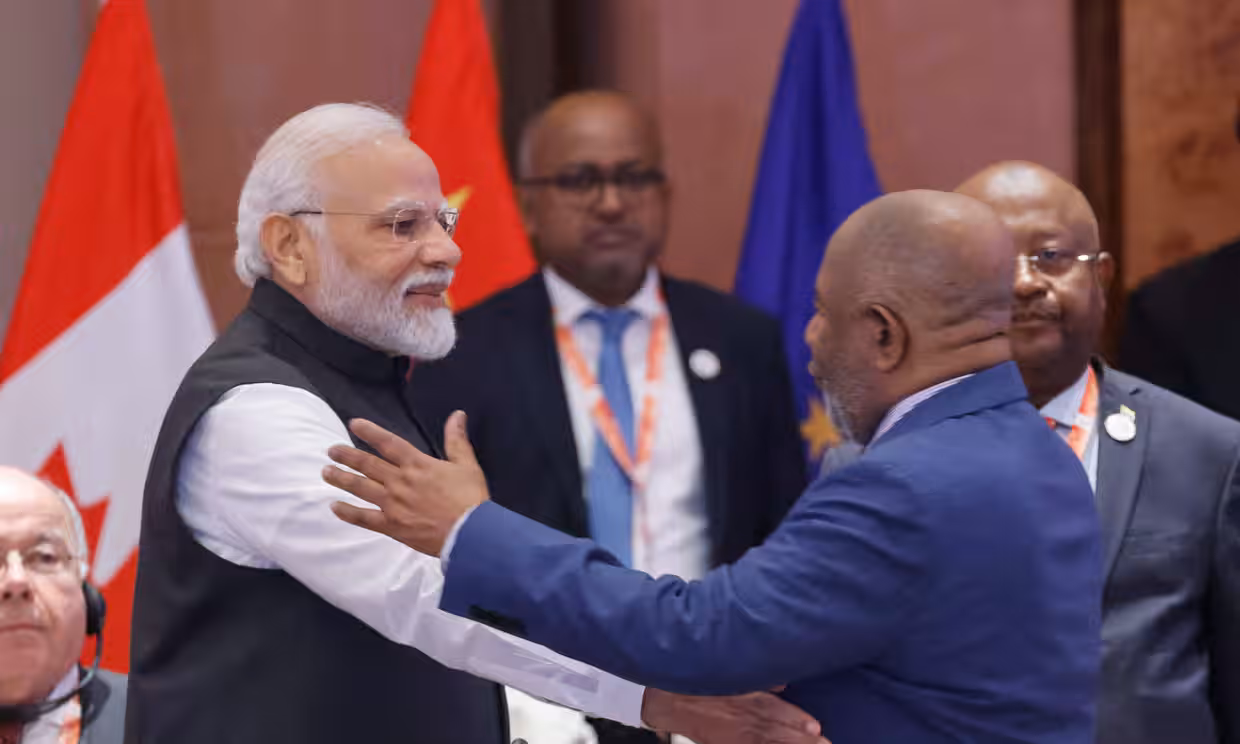
NEW DELHI – During their annual summit in New Delhi, the Group of 20 (G20) major world economies officially included the African Union (AU) as a member. However, the summit faced challenges related to Russia’s war in Ukraine, with India having to make compromises to achieve a consensus on the final statement.
India had struggled to find common ground on Ukraine’s wording in the months leading up to the G20 summit. China and Russia had objections, even to language they had previously agreed upon at the previous G20 summit in Bali.
The final statement, released a day before the summit’s formal conclusion, acknowledged the “human suffering and negative added impacts of the war in Ukraine” but did not explicitly mention Russia’s invasion. It cited the U.N. charter, emphasizing that all states must refrain from using force to acquire territory or threaten the sovereignty of any state. The Bali declaration had explicitly condemned the Russian Federation’s aggression against Ukraine.
Western delegations celebrated the agreement, with German Chancellor Olaf Scholz describing it as a “success of Indian diplomacy.” The European Union also noted the importance of Russia signing the agreement, even though it had not compromised its position.
The primary focus of the G20 summit was the addition of the AU as a member, following the European Union, making it the second regional bloc to gain permanent membership. This move supports Indian Prime Minister Narendra Modi’s goal of providing a stronger voice to the Global South.
The earthquake in Morocco, which occurred while most delegates were asleep, brought the African continent into the spotlight. Modi expressed condolences and support for Morocco in his opening remarks, emphasizing the need to address global challenges such as economic disparities, regional divides, and issues like terrorism, cybersecurity, health, and water security.
Modi’s emphasis during the summit was on addressing the needs of the developing world. However, many issues, such as food and energy security, were linked to the ongoing conflict in Ukraine.
The G20 summit came shortly after Russian President Vladimir Putin’s announcement that a crucial deal allowing Ukraine to export grain safely through the Black Sea would not be reinstated until Western nations met his demands on Russia’s agricultural exports. The G20 called for the resumption of grain and food shipments from Russia and Ukraine, highlighting their significance in feeding people in developing regions like Africa.
The G20 includes Argentina, Australia, Brazil, Canada, China, France, Germany, India, Indonesia, Italy, Japan, South Korea, Mexico, Russia, Saudi Arabia, South Africa, Turkey, the United Kingdom, the United States, and the European Union, with Spain holding a permanent guest seat. Russian President Vladimir Putin and China’s leader Xi Jinping did not attend the summit this year.
The summit’s agenda covered critical issues for developing nations, including hydrogen as an alternative fuel, resource efficiency, food security, and the development of a common framework for digital public infrastructure. Human Rights Watch urged G20 leaders not to let international disagreements on Ukraine overshadow discussions on these vital issues.
During the summit, India, the United States, the European Union, and others unveiled ambitious plans to construct a rail and shipping corridor linking India with the Middle East and Europe. This project aims to enhance economic growth and political cooperation and was hailed by President Joe Biden as a “really big deal.”